Showing posts with label death. Show all posts

Thursday, September 25, 2014

Philippines: The Very Bewildering and Lethal Floods

by the Resource Recovery Movement, Center for Human and Society

In the recent period, floods plagued a considerable area, encompassing broad sections across the globe.

Heavy recent flooding in India and Serbia, China, Japan among many other areas around the world

With heavy inundations such as these that can often kill with their own sheer power by drowning, is there still a need for the water to be poisonous, toxic and very much hazardous to health or even deadly enough to kill?

In the Philippines, not the Secretary of the Department of National Defense now a bit too advanced in years unlike many past defense secretaries who braved calamities and got wet and dirty on the ground, but the helmsman of the National Disaster Risk Reduction Management Council (NDRRMC) is a mite too busy nowadays. The chief is extremely tied up in many corners that at most times the poor disaster response executive does not even know where to plant his foot next.

Yet it is an inescapable Catch-22 situation. If the new chief of the Philippine Office of Civil Defense and the Secretariat of the NDRRMC follows the examples of his bosses, just stay put and let things unveil all by themselves, the people will be angry.

If the NDRRMC head appears very mobile and busy, the people are still not going to be appeased. They will be just as angry anyway. No option is a better one, even that of balancing between not doing anything and making an effort to be hyperactive.

A senseless new tragedy most recently hit the Philippines - not so much a tragedy as thousands of helpless citizens getting killed.

The powerful storm caused a maritime vessel Maharlika II in Cebu to drown, leaving as many as more than one hundred casualties. As of this writing, 70 persons are missing due to the tragedy.

All over the nation: Floods and landslides, destroyed crops, dead farm animals
ruined houses, buildings, vital installations and much more other forms of damage

A really sensible government will take every means to prevent people from getting caught in floods. Sadly enough, this is never true in the Philippines and not in many places around the world. They will simply snort: Expensive solutions! No one specially me needs them! So they let whole communities drown or suffer getting submerged waist or neck-deep in murky, life-threatening floodwaters
Both children and adults brave the waters in floods. No one puts the fear in their hearts that doing so is extremely dangerous to their health and the effects may only be felt after a long time.

Nevertheless, billions worth of agriculture and aquaculture crops, installations, homes, school and other low-rise buildings, among many other infrastructures were destroyed by tropical storm Mario. Metro Manila was paralyzed once more, although not as severely as during Ondoy.

Not only during exemplary, isolated cases, but definitely and specifically because of the recent calamity called Mario, and in the near future, several more typhoons, people are sick or will be taken ill by longer-gestating diseases and the ground including everything in it is gradually being poisoned.

A tremendous number of people were submerged under the floods, once again that God knows how much harmful these unclean and contaminated flood waters have made hundreds of thousands to millions disease-prone. The water resource systems interacting with these floods are also polluted and infected with harmful, health-threatening elements.


The question is: What is the sense of getting over busy over distributing relief clothes, evacuating thousands of citizens and heavily disrupting lives, distributing difficult-to-swallow disaster ready-made food, providing skin-deep medical assistance when people will be dying anyway, people will be getting sick, people will lose all their belongings, farms, fish ponds while all the decisions being made in the first instance are clearly very wrong?

Before the disaster responder has acted, someone preceding him has made the situation superlatively dreadful that when disaster strikes, it is expected that masses of people will become vulnerable and not in a slight or tangential way.

Most of these individuals or groups (associations, enterprises or corporations) are not bothered by conscience since they believe they are not doing anything criminal or immoral at all. So they continue to live pleasured existences without a care for the victims of future disasters whose deadly impact they had caused to be magnified by a significant number of multiplier variables.

And so they are the very reason why the chief of the NDRRMC and the disaster response workers, the social work and local elements delivering relief, the emergency and health services personnel, peace and order officers, the military undertaking humanitarian assistance, among too many others, will be very, very hard at work.

And all for a very senseless reason that unscrupulous, morally corrupt and insane individuals and institutions caused massive fatalities, casualties and damage when there ought to have been minimal injury and impairment of the ecology had better and caring practices been done instead of the unconscionable, wantonly destructive ways of selected unworthy, cruel, ruthless members of society.

Those whose lives and belongings will be touched by the disaster, will certainly suffer in the most horrible circumstances; if help doesn't come they either die and fade away into oblivion or experience their agony over a long, painful terminal period. The misery does not end even when they survive. In some cases, their pain and torment or physical afflictions – the experience of loss or damage to their valuables - become even more severe.

Needless to say, in the case of Haiyan (Yolanda), the relief was too late in coming simply because the public sector sat on the problem and got bogged down by its own undoing: improved logistics for delivering aid to victims of calamities.
 
Before the disaster responder has acted, someone preceding him has made the situation superlatively dreadful that when disaster strikes, it is expected that masses of people will become vulnerable and not in a slight or tangential way. . . .

Most of these individuals or groups (associations, enterprises or corporations) are not bothered by conscience since they sincerely believe they are not doing anything criminal or immoral at all. So they continue to live pleasured existences without a care for the victims of future disasters whose deadly impact they had caused to be magnified by a significant number of multiplier variables.


Still however, Undersecretary Pama is at the place where solutions for a multifaceted, convoluted problem such as the dangerous exposure of people to floods at the risk of being taken seriously sick or even dead. A little less could be said about home appliances and vehicles; their rate of survival is slightly lower than for their owners and guardians.

Obviously, every flood victim will not hesitate to say the government has done it again and needs to stop. Are the people familiar, contented with or immune to waist and neck-deep flood in Metro Manila, Central Luzon, Ilocos Region and many other areas?  In some cases, flood waters reached overhead height.

It is common knowledge that treading, wading in dirty flood waters is inimical to the health of both humans and animals. Information and education campaigns abound about not dipping or submerging the body or any part since it is a serious health hazard.

Extent of floodwaters made parts of Metro Manila look like islands in the midst of the sea and boats just needed to be on the scene as if they were part of the woodwork

Yet aside from surface runoff water, most particularly in Luzon government decided as it has always done on its own with careless abandon, to release excess water from dams.

This action clearly endangers communities without alternate canals and floodway systems. Even when the public sector deems it sensible and proper to commit the act, the consequences should have been done with prudence and with a number of fallback positions considering the high level of danger it poses to the citizenry.

As a matter of fact, if the public sector is truly adequately sensible, since this act of releasing hundreds of thousands of tons of excess water from dams is perilous, during the non-rainy periods, pro-active measures ought to be done. Even if many or most of these measures are really all too expensive.

The Philippine Government under Mr. Benigno Simeon Cojuangco Aquino III has proven that it can arrogate discretion onto itself, over more than one hundred billion pesos for gifts to legislators, executives and insignificant projects. No reason that several billions can be dedicated to combating floods coming from the deliberate releasing of excess water from dams into communities.

Certainly, to undertake solutions such as creating river bypass is expensive. The entire cumulative weight of past administrations never took it to themselves to accomplish this. Yet they may have all but justified their inaction by the mere fact that only during this Aquino regime are storm surges, flash floods and deluges caused by released water from dams more deadly and more pronounced.

Whether or not dozens, hundreds, thousands died or not in the recent Typhoons Glenda and Mario, the mere fact that Metro Manila as in the occurrence of Typhoon Ketsana (Ondoy) and Super Typhoon Haiyan (Yolanda), suffered hundreds of thousands, millions of people with pestering floods is an indictment on society for not being able to deal with flood control.

From the 1970s up until recently, storm surge was an unheard of concept. While Typhoon Ketsana (Ondoy) was fatal along with Frank and other similar calamities during the immediate past regime, the new kind of storms and super typhoons visiting the Philippines in recent time are much more powerful.

The extent of hazards therefore accompanying public sector decisions to wantonly release flood-causing waters from dams are presently multiplied.

No past president and their minions have ever taken it into their resolve to solve this malingering problem of placing people at risk every time heavy rains occur and high critical levels in dams are breached, forcing the gatekeepers to release tons of floodwaters into communities full of helpless citizens.

Then rescue, relief and recovery of both living bodies and dead corpses is undertaken. Huge amounts of funds are earmarked for such post-disaster actions with little or no money to pay for the salaries of less than four hundred NDRRMC casuals about to be retrenched. No early countermeasures or pro-active long-term solutions are applied.

As far as a substantially decent space of time to allow the victims of floods to prepare and evacuate is concerned, there can never be any. Since forecasting not only in the Philippines is a sham. In many areas around the world today, forecasting is useless, particularly when it concerns floods or related forms of geo-ecological hazards.

The recent tropical storm Mario provides insights into how the country's scientific community and leading disaster risk reduction agencies can prevent the fiascoes of Ketsana (Ondoy), Haiyan (Yolanda) and Typhoon Fong-wong (Bagyong Mario).

If there is still rationality abounding amidst the mad rush to grab skim money or collect separation compensation due to the fast-diminishing period of the stay in power of the Aquino regime, some appropriate solutions need to be applied to the lessening of the impact of heavy rains such as heavy flooding upon communities or eliminating the risk of spreading toxicity from the overflowing flood waters.

All these insights can be applied and appropriate services can be delivered that will benefit the population of communities that clearly are unnecessarily being pestered by floods that should not be in their homes in the first place.

As it had constantly been espoused, there is a need to provide the public with a more decent lead time to safeguard their homes and valuables, and most especially their own life.

The current alert system of the government does not take into account the deadly and fatal impact of extreme flooding that takes lives and property in its wake.

The people in communities are being blamed for dumping garbage everywhere with complete abandon. However, the public is paying heavily for taxes going to garbage collection, solid waste management, with much of these funds being pocketed by local officials and higher officials.

If taken cumulatively, the skim from the funds purported to be paid to favored garbage collection business organizations, among many other public sector dealings concerned with important aspects of public sector services and activity that unequivocably contribute to the hazards brought about by floods is literally a real mountain of cash.

Too many billions of cash both supposedly lie dormant and on the other hand, continue to get collected from the unsuspecting public for sewerage management. For the past more one decade since waterworks and sewerage services have been privatized, the private water utility companies in Metro Manila for instance take and keep the money for sewage management. Where is all these money going to? What are they doing with it?

A past Director - a top level executive of the Asian Development Bank, lamented both the Maynilad and Manila Water, inherited from the old Metropolitan Waterworks and Sewerage Systems (MWSS) – popularly still known as NAWASA – and added on some minor components to, sewage treatment facilities for Metro Manila. Most of Metro Manila, most of the towns and cities in the outlying regions, have not moved forward from the practice of employing septic tanks as septage collection system. (See related articles: In Defense of Septic Tanks.)

However, sludge-carrier transport suction off the unleached waste and transport these septage from various points in Metro Manila to the Sewage Treatment Plant (STP) facilities at the Food Terminal Inc. (FTI) in Taguig City but even these collection points overflow when there are floods.

Simple extended rainfall permeating through the STP tanks will already force these facilities to spill out their contents and pollute Taguig and other areas.

It is such a mystifying circumstance that the Food Terminal Inc. in Taguig City is also a collection and storage point for freshly harvested and preserved imported food items.

When the inadequately sized Sewage Treatment Plants inexorably overflow, why the decision to keep them in a place where they will ultimately come in contact with and contaminate food stuffs intended for millions of the consuming public – both the locals and foreigners? Sen. Peter Cayetano of Taguig City who is running after the head of the Vice President cannot sufficiently elucidate about this because he too, like many disaster responders, is exceedingly busy and most possibly will refuse to help you and me. Even if you simply want to know whether the food storage areas were reached by the floods, he probably might not tell neither you or me too. Whoever can satisfactorily provide an explanation for this quandary would really be someone equipped with an exceptionally superior intellect bordering on genius.


The deliberate contamination of the water resource system is not being stopped because no one believes that a poisonous or health threatening lake, river, canal, is not dangerous even if it kills people, fish, other forms of life that it will come into contact with particularly during flood. Simply because the death was caused by a disaster. And everyone is bound to swallow the sad justification that during disaster anything – especially bad things – do happen so that no one or nothing else is to blame.

New scientific knowledge, novel technologies abound and proper processes, procedures, methods - by design are in place – but these are not being constructively made use of and will not be employed for a long time unless an institution like the NDRRMC or another more powerful cluster will take positive action.

It is not enough to be mouthing justifications about the people throwing garbage all around thoughtlessly, without considering the effect on the environment.

A useless effort to keep blaming everyone else but the key people who ought to have done something to make the situation right.

Whether or not dozens, hundreds, thousands died or not in the recent Typhoons Glenda and Mario, the mere fact that Metro Manila as in the occurrence of Typhoon Ketsana (Ondoy) and Super Typhoon Haiyan (Yolanda), suffered hundreds of thousands, millions of people with pestering floods is an indictment on society.

The sin is not being able to deal with flood control; taking measures to secure the citizenry from possible disease or death brought about by the harmful wastes and toxins present in dirty flood water; not being able to provide safe spaces for people that get trapped in the floods and most of all, the inability to safeguard the people from both the effect of the calamity or acts that criminals do when people are herded to evacuation centers leaving their abodes wide open to invasions.

A horrendous amount of money is available to control, minimize or eradicate flooding not only in Metro Manila but also in all other parts of the country.

Along with these resources are also funds for making the ecology safe from hazardous and toxic elements that could permeate into surface and ground water.

These funds are hardly accounted for by those that ideally should be protecting or keeping the people away from toxins, poisons, health hazards that are present in flood waters. However, such kind of civil servants hardly exist in the present setting.

Even if the positions of such kind of public servants will be created, there is no guarantee that anyone would want to fill the slot since the conventional wisdom is not exactly to stop flooding from killing people and damaging property, agriculture and aquaculture ecosystems.

It appears that everyone's conviction is just to allow water to find its own level, do nothing about it, and let it commit mass slaughter, wreak havoc on private and public property, wherever it will find itself in. Those that cold-bloodedly release water from dams, simply think "Bato bato sa Langit, ang tamaan, huwag magalit." (Rock coming from the Heavens, make them not angry whosoever is hit.)

It is such a mystifying circumstance that the Food Terminal Inc. in Taguig City is also a collection and storage point for freshly harvested and preserved imported food items. When the inadequately sized Sewage Treatment Plants inexorably overflow, why the decision to keep them in a place where they will ultimately come in contact with and contaminate food stuffs intended for millions of the consuming public – both the locals and foreigners?

Funds that should have helped stop heavy flooding
and prevent toxins in surface and ground water
  • Sewerage Management Collections by Private Water Utilities – local and foreign (1970s to present)
  • Dam Construction and Management Operation – local and foreign (1970s to present)
  • Regulatory funds to control use of toxic, hazardous materials by construction activities and organizations – local and foreign (1980s to present)
  • Wetlands Management – local and foreign (1990s to present)
  • Flood Control Program – local and foreign (1970s to present)
  • Privileged garbage collection businesses – local (1970s to present)
  • Local Government Units funding for managing garbage disposal (1970s to present)
  • Foreign-Assisted Programs for Solid Waste Management – (1980s to present)
  • Funding for the Environmental Management Bureau of the environment and natural resources department (1970s to the present)
  • Other fund sources – local and foreign
Perspectives on Safeguarding Water Resources from Deadly Toxic Elements, Hazards to Human Health and the Ecology

The causal effect of obnoxious current practices upon all our water resources is extremely damaging but the pull is towards not doing something about the existing system.

The deliberate contamination of the water resource system is not being stopped because no one believes that a poisonous or health threatening lake, river, canal, is not dangerous even if it kills people, fish, other forms of life that it will come into contact with particularly during flood. Simply because the death was caused by a disaster. And everyone is bound to swallow the sad justification that during disaster anything – especially bad things – do happen so that no one or nothing else is to blame.

New scientific knowledge, novel technologies abound and proper processes, procedures, methods - by design are in place – but these are not being constructively made use of and will not be employed for a long time unless an institution like the NDRRMC or another more powerful cluster will take positive action.

For the past few decades, new means for collecting septage or liquid waste from households and industries before they are leached has been present. Still, however the very ancient method of using septic tanks appears to be the practice that will be in place for another hundred years – even if this system is extremely unsafe.

Reckless Wholesale Dumping
of Agro-Industrial Waste


According to the former President of the Association of Employees of National Defense (ASEND), during the regime of the late Ferdinand Marcos, the Department of National Defense (DND) with accompanying officials of the environment management and regulatory office, led in the relentless apprehension and arrest of owners of industrial establishments along the Pasig River that unlawfully and without sensitivity to those that will be affected, release their toxic effluents into the River Pasig.

This was the 70s until the 80s. Each time the detained owners would only stay for a few hours and will be released. After some time, they are back in their old practice of toxifying the ecology over and over again that leads to their repeated arrests. Their modus operandi is dumping their waste surreptitiously during or after midnight when everyone else is resting.

Most of those that are arrested are Chinese. When interrogated over why they keep on repeating the same violations and why, those Chinese business owners say: "It is okay to be arrested; I will just pay the fine after all its just very small money." Up to this date, the same practice has been going on at the Pasig River and in many other rivers in the country.

In a certain part of the Marikina River system, the waters are full of the detergents as well as manure and urine from the pigs of the animal fattening business called Foremost Farms as well as too many other agro and industrial establishments in the area.

Nearer to the Foremost Farms, if one's bare or protected feet are exposed to river water, either the skin or the shoe and socks protecting the foot will immediately get damaged by the potent chemicals and the feces of pigs poses dangers to health.

As early as the 1980s, enforcers conceived of the solution of penalizing violators of environmental regulations with stiffer sanctions and greater fines. Up to this date, it is unheard of to fine the polluters of poison into the environment with multimillion fines. Instead multimillions go to the dirty hands of environment managers, subnational and local government officials that may reprimand or remind the outlaw businessmen that they need to heavily grease a few to be allowed to continue their criminal excesses.

Fixation Upon Obsolete Septic Tank Practice

In the old times some hundred years ago, it was novel and possibly just and respectable to call the septic tank as a technology. This is no longer true today. Sadly however, up to this date, many business organizations continue to believe in the conventional wisdom that the septic tank system is still the only correct way of dealing with household and industrial septage.

Septic tanks have acquired fantastically new and modern, even aesthetic features. Even in the old times, those that used the septic tank thought it very high class to use expensive material like marble, granite, even expensive metals for their septic tanks. Today the ordinary concrete or brick septic tanks are being replaced by highly modernized fiber glass, hard plastic, or such other material as long as these will be non-porous – which is the dream of septic tank installers and promoters of the septic tank system.

Furthermore, very little care is done in the use of septic tanks such as in preventing chemicals like "bleaches, disinfectants, harsh house hold cleaners and anti-bacteria detergents... Oils, fats, grease, coffee grounds, paper towels, sanitary napkins, diapers, hand wipes and other such items will clog (your) septic tank system and drain field."

Owners of these kind of tanks are admonished by septic tank experts that they should "Never use motor oil, garage cleaning solvents, lubricants, gasoline, paints, thinners and insect pesticides in drains. These materials may pollute the groundwater and are toxic to the microorganisms that maintain an active septic system.

Overflowing Septage Tanks


There is no guarantee that none of the dirt and contaminable ingredients inside  septic tanks will spill out during floods, particularly in the Philippines where the septage collection technology is too ancient and unreliable. 

In an old Quezon City condominium to cite one example, where sixteen residential units built in the 1970s-80s share just one septic tank on one side of the building, another sixteen share another single septic tank on the other side, no septage maintenance is being done by the condominium owner.

As a result, flood or no flood, when the septage overflows, it goes into the bath of the ground floor residents of the condominium.

On the other hand, when the waterworks utilities decided to remove several decades-old rusty and dilapidated potable water pipes that were regularly contaminated by the escaping effluents from the septic tanks, they replaced the same rusted pipes with synthetic PVC pipes. Due to excess pressure, the PVC pipes break and thus the contamination is on again. The people in those condominium buildings have been using potable water infused with blessings from the septic tanks.

Even the Sewage Treatment Plants (STP) themselves, have very low holding capacity that each time heavy rainfall occurs, are also filled up to overflowing levels and all the excess effluents go inevitably into the riverine, canal, stream, creek receptacles, spilling over into Metro Manila or other towns' and cities' streets and smack into the doorsteps and inside the household of ordinary citizens.

Floods, fires and other catastrophes natural or human-made guarantee equal opportunities or tragedies for both the rich and poor, depending upon how secured the prospective victim is. Disasters are failures when it comes to choice: Kings, Queens, Presidents and Ministers just like everyone else in the masses are not immune to the dangers of being swept away by storm surge, powerful tornadoes, killer earthquakes and other hazards.

Resolving the problem of toxicity
and other hazards from floods

Clearly some positive, pro-active measures need to be done – with all the lessons learned from past disasters not only in the Philippines such as those from Ondoy, Yolanda, Glenda, Mario, but from other countries as in the case of the earthquakes in Japan and Haiti, Hurricane Katrina in the United States and many others.

If there will be no constructive actions taken, with the government forecast of five to eight more strong tropical storms or typhoons coming to the Philippines before the end of December 2014, the problems about floods and their attendant predicaments could create mountains of setbacks for the country.

Every manager knows that prevention is so much better than damage control: here is therefore where the NDRRMC can play the hero. With nearly all of the government departments represented in the Council, all the needed requirements for undertaking pro-active solutions are present.

It will not take too much planning to start one or two doable projects to creating river bypass or providing ways for water not to accumulate much more abundantly in Metro Manila, Calabarzon or Central Luzon's heavily populated areas.

Most of all, as much as can be done to the best human capability as possible, to deflect the flow of the flood wherever septic tanks are concentrated, for single household or industrial user or the larger ones for multiple users (some septic tanks such as in Aurora Province hold the refuse of not only an entire barangay but a large portion of the capital Baler, Aurora and this large, multiple user septic tank – for the love of God Almighty - is located next to the main Baler river).

This holds true also for the places where the Sewage Treatment Plants are located. Flood waters must be redirected so as not to allow these STPs to overflow. What is the use of leaching plants when their sludge and dirty waste water are deposited into the mainstream community to contaminate the water supply or afflict people and animals with illnesses, toxify plants?

Too many post-disaster Johnny-come-late, Johnny-do-good acts will become unnecessary if and when less people are exposed to flood. Further, the funds for relief and the donated goods to feed evacuees or in place victims are fewer – therefore giving lesser opportunities for vultures stealing these resources for their pockets and minimal chances the vultures will offer the goods for sale to commercial distributors like the malls in Divisoria, Manila that up to this time very unabashedly and instead with great pride display the donated relief items intended for Yolanda.

The problems that go with flooding are not extremely complex however it should not and never be assessed simplistically with the aspect of throwing away small to large amounts of garbage indiscriminately and inconsiderately.

A lot needs to be done and much of their accomplishment will depend upon super bodies like the NDRRMC or a more powerful cluster.

But the time for waiting is way past over a very long time ago, so some catching up action has to be done now and not any day later.

Let the people be safe from dirty and toxic elements in runoff water and minimize flood borne illness, death as well as contaminations of whatever the spill over waters touch. The next time you dip yourself in a flood, remember that you might not be safe. The next time you open your mouth to take in food, find out about whether floodwaters reached Taguig City's Food Terminal Inc.

Posted Under Themes:
#MarioPH
#Fong-Wong #Fung-Wong
#Flood
#Philippines
#FloodControl
#RescuePH
#Rescue

Saturday, December 28, 2013

Forecasting with more confidence: extended discussion

If you warn them and they keep on sinning and refuse to repent, they will die in their sins. But you will have saved your life because you did what you were told to do. If good people turn bad and don't listen to my warning, they will die. If you did not warn them of the consequences, then they will die in their sins. Their previous good deeds won't help them, and I will hold you responsible, demanding your blood for theirs. But if you warn them and they repent, they will live, and you will have saved your own life, too. . . Some of them will listen, but some will ignore you, for they are rebels.
<< Ezekiel 3:18-22 >>

For I was hungry, and you didn't feed me. I was thirsty, and you didn't give me anything to drink. 43 I was a stranger, and you didn't invite me into your home. I was naked, and you gave me no clothing. I was sick and in prison, and you didn't visit me.' 44 "Then they will reply, 'Lord, when did we ever see you hungry or thirsty or a stranger or naked or sick or in prison, and not help you?' 45 And he will answer, 'I assure you, when you refused to help the least of these my brothers and sisters, you were refusing to help me.' << Matthew 25:41Matthew 25:42-45 Matthew 25:46 >>


Self-doubting prophecy
Forecasting in the future with greater confidenceView or Download the pdf format here

Nearly five years ago today, it was suggested to the Philippine Atmospheric, Geophysical and Astronomical Services Administration (PAGASA) to enhance its satellite capability instead of simply getting hand-me-down issuances from UN OOSA (United Nations Outer Space Affairs and the NOAA (United States National Oceanic and Atmospheric Administration) and the other geospatial information and intelligence agencies all over the world.

At a certain point in time around the period of the occurrence of the devastation by tropical storm Ketsana (Ondoy) in the Philippines, the PAGASA was clamoring for the purchase and installation of its Doppler radar system, an outmoded and unreliable system for weather forecasting.

In 2010, all throughout the government circuit, the company of Mr. Philip King called AAA, went on a lecture-presentation effort to sell the sensing and image capture technology developed by a Malaysian scientist and technology specialist who was also engaged in a similar high technology, extensive venture for the government of Canada, among other countries.

Had the Department of Science and Technology considered using a network of sensing stations with clear-photo capture capability on a 1-camera-per-station (or possibly a cluster of cameras), weather forecasting in the country, aided with charity hand-outs from NOAA, UNOOSA, the European Union, among other satellite capable agencies, will definitely be more precise at the same time vivid and viewable in real time.


It was foreseen in this site that absolutely nothing will be allowed by Typhoon Ketsana (Ondoy) to block its path. As early as the morning of the raging of this typhoon that PAGASA decided to merely attribute the powerful rains and killer floods to monsoons, it was already the consensus among the advocates that started this site that many people will die by Ketsana (Ondoy).

What kind of weather forecasting transpired during Typhoon Ketsana (Ondoy) was that by 10:00 AM up to 12:00 noon, PAGASA continued to refuse to declare even a Storm Signal No. 1 for Metro Manila and Rizal Province even at the height of severe rainfall, destructive and killer floods hitting entire subdivisions in Marikina and parts of Rizal, large areas in the urban center of the national capital.

In real time, it was being recommended strongly by this site that a state of calamity and state of emergency already be declared by the Office of the President.

When the media started reporting, albeit belatedly, that some people were reportedly getting killed by Ondoy, it may have dawned on PAGASA that their forecast needed to be amended. Nearing nightfall when panic and frenzy hit the public due to massive negative reports reaching media and feedback filtering through to the lower and highest levels of government, PAGASA relented and finally announced Signal No. 1. It was too late, Malacañang was then preparing to announce a serious state of calamity for the entire Metro Manila including parts of Rizal.

Hundreds died in Provident Village in Marikina. Hundreds died inside a popular Mall at the Riverside commercial complex built beside the huge Marikina River. Still hundreds others were swept by raging waters or seriously injured by stampeding objects and died instantly or were killed by being in the flood and unable to get help for their injuries.

The Haiyan (Yolanda) Fiasco

If the PAGASA did actually issue a warning, albeit introverted and timidly, about the storm surge in coordination with the rest of government, the evidence of the storm surge warning only appears at 5:00 AM on d-day, three hours before the storm surge hit Tacloban City on November 8, 2013 in the national disaster risk reduction agency (NDRRMC) Advisory called Severe Weather Bulletin No. 6.

Still and all, much, much earlier that day, Super Typhoon Haiyan (Yolanda) already passed through Tolosa, Leyte and hit neighboring towns beginning its slew of devastations across the entire length of nine Regions of the Philippines.

The NDRRMC Bulletin stated that:
"Residents in low-lying and mountainous (sic) under signal #4, #3, and #2 are alerted against storm surges which may reach up to 7-meter wave height (sic)."
ACTIONS TAKEN
o   NDRRMC Operations Center disseminated Severe Weather Bulletin No. 6 on Typhoon Haiyan (Yolanda) to all OCD Regional Centers through SMS and facsimile and uploaded on the NDRRMC website for further dissemination to their respective local disaster risk reduction and management councils (LDRMMCs) from the provincial down to the municipal levels
o   Directed RDRRMCs concerned through the OCD Regional Centers to undertake precautionary measures in their areas of responsibility (AOR) and subsequently advised local DRRMCs to initiate pre-emptive evacuation of families in low-lying and mountainous areas if situation warrants.
Had the one preparing the Severe Weather Bulletin (SWB) not merely cut and paste from one SWB to the next as can be observed in the various and different advisories issued by the NDRRMC, it must have been possible to introduce some new wording into these so-called severe bulletins.

The NDRRMC should have issued directives instead of the de cajon ACTION TAKEN jargon of "take precautionary measures." The directives could have contained marching orders coursed through the Regional Disaster Risk Reduction Management Councils (RDRRMC) of which the following are members, such as:

1. Armed Forces of the Philippines (AFP)
In connection with the warning of the threat of 21-foot or 7-meter high wave height as stated above, the AFP is hereby ordered to undertake, without need of callback and setoffs, forced evacuation to higher ground of all affected elements and population. . . This is not a drill.

2. Philippine National Police (PNP)
In connection with the warning of the threat of 21-foot or 7-meter high wave height as stated above, the PNP is hereby ordered to provide all manner of assistance to the AFP in the forced evacuation of all affected Service elements and population to higher ground, without need for callback and set off. This is not a drill.

3. Department of Social Welfare and Development (DSWD)
In connection with the warning of the threat of 21-foot or 7-meter high wave height as stated above, you are hereby ordered to comply with the forced evacuation order issued to AFP and PNP and to provide all manner of assistance and coordination with all affected officers and personnel of your agency and every item of relief designated for the evacuees, without any need for callback and set off. This is not a drill....

Just because the so-called Severe Weather Bulletin, did not emphatically state to forcefully execute an evacuation to safer ground, people who were caught by the storm surge unaware, got drowned and helplessly died under these 21-foot high waves from storm surges.

In Ground Zero in Tacloban City, two sets of 20-foot high waves converged from opposite directions to create more or less 40-foot high deluges. Even several hundred-ton to several thousand-ton ships were lifted by these approximately 15-meter high waves and brought into the ground in Tacloban City.

If multiple thousand ton objects such as ships, as in the Japan tsunami of 2011, could be lifted by the storm surge into the ground in Tacloban City, it would have been impossible for many people to survive the power and strength of the raging waters, accompanied by the stampede of debris from everything that the flash floods caught along the way.

All the rest of the highly authoritative Severe Weather Bulletins of NDRRMC do not contain a definitive order to evacuate nor even a redundant very stern warning about storm surge and a powerful order to vacate unsafe ground to ensure one's safety and survival.


Bountiful confidence,
ill-preparedness and risk
mitigation cost-cutting by
Governments
  
In the case of Tropical Cyclone Haiyan (Yolanda) government had the proper information, but it was never shared and properly explained to the people who would become helpless victims. The public image this projects, if the PAGASA keeps repeating that they were in possession of the data about the deadly storm surge, the information was never really given much import.

On top of this, PAGASA and its sister agencies in government, two weeks after the extremely tragic incident, are saying through the ABS CBN and all the other Philippine media outlets that the warning about storm surge was already issued two years ago.

Needless to mention, the ideal role of the public sector forecasting and disaster readiness cluster consist of very simple functions:

1.  Ensuring people safety (Detecting, forecasting)
2.  Making people know (Announcement)
3.  Making people understand (Brief Narrative, Explanation in Laymen’s terms)
4.  Providing the people a course of Action (Command)

All these things require on the other hand, the following support factors:

1.  Forecasting Technical Capability
2.  Credibility
3.  Delivery Mechanism (Public Warning and Briefing System)
4.  Capacity Building (Training, Educating People)
5.  Quick Response Capability
6.  Evacuation to safe haven
7.  Relief, Rescue and Recovery
8.  Forensic and mortuary operations (in case of MCI)
9.  Rehabilitation, Reconstruction

In evaluating and assessing the behavior of the Philippine weather bureau – Philippine Atmospheric, Geophysical and Astronomical Services Administration (PAGASA) prior to and during super typhoon Haiyan (Yolanda), it is clear that scientists and managers of PAGASA and Philippine Institute for Volcanology and Seismology (PHIVOLCS) cannot serve fittingly by being trapped in ivory towers or hermetic refuge.

Further, it is not to the benefit of the greater public at large for scientists at PAGASA and PHIVOLCS to slowly grow into the seductive role of reporters for broadcast networks.

On the other hand, the disseminators of early warning did nothing positive as shown above. To compound the situation, it was barefacedly reported to the public over the government’s national television network by a representative of the Office of the President’s Philippine Information Agency (PIA) eastern Visayas regional office that she had sent numerous SMS to local government officials through the Philippines Smart Telecom Text Blast application about the storm surge reaching as high as 21 to 30 feet.

This method of communication proves to be very inexpensive for the PIA and government as a whole, but fatal for the unknowing public.

Up to the very final minutes prior to the 0800H 08 November 2013 onslaught of super typhoon Haiyan (Yolanda) the female PIA Region 8 official said she was still sending text messages and called someone on mobile telephone and during her talk with the called party, she overheard the powerful sound of the raging waters that engulfed whoever it was she was warning about the danger. Silence followed, she told the People’s Television Network anchors and studio audience.

The same agency, PIA Region VIII stated that the government prepositioned relief goods. That all these prepositioned relief goods were destroyed by the storm surge that she had clearly been informing local government officials about. 

If the government actually knew about the storm surge clearly, why supposedly preposition the relief goods in the very area where the storm surge will damage them?

The international media declared that a lot of statements made by the Philippine public sector about Haiyan (Yolanda) appeared to be dubious, suspicious for being highly contradictory. Without doubt, this brought the untimely death of +6,000 people.

After the super typhoon devastated mostly Tacloban City and nearby towns, humanitarian relief assistance did not arrive until after more than nearly two weeks.

At the time of the disaster, only the wife of the local chief executive was in the locality, some quarters say.

Her spouse, the local executive, was one thousand one hundred three kilometers (1,103 km) away participating in extreme sports – highly confident that disaster readiness actions were undertaken.

While the father of the City and his family was far away, the lady of house was reportedly hit by the storm surge and barely survived; she had to make do in the aftermath of the typhoon with receiving food and borrowing personal items from her closest friends. 

On the other hand, the Philippine President, His Excellency Benigno Simeon Cojuangco Aquino III, President of the Philippines declared that the “Systems failed, what else could he have done?”

During his press briefing at Tacloban City on November 18, 2013, ten days after the super typhoon, President Aquino complained about the overwhelming power of Haiyan (Yolanda) that all systems went down.

The government workers became victims themselves. Relief goods were damaged.

President Aquino could not mention that along with the relief goods in the government base operations center that had spacious room for evacuees, the helpless people drawn out of their homes during evacuation procedures and brought beside the relief goods, died from the storm surge inside the evacuation centers.

As for the relief items, these are all in a list and no one needs to account for them now. Still, solutions to these kind of oversight need to be applied in the future.

Social, Political Perspectives

It is evident that several questions need to be answered. Prior to the incident, why a local executive would hurry off to participate in extreme sports in a place not predicted to be hit by the super typhoon is certainly an issue.

Were the weather forecasts not enough to convince this local government head of the danger to his area of responsibility?

After the incident, why the foremost leader of the country will delay the staging of humanitarian relief and assistance operations for a wholly devastated part of the country will be remembered by the people in the Philippines for a very long time.

Nearly a week after November 8, 2013, why a public sector weather bureau officer would state on national media, three days after Typhoon codename Haiyan aka Yolanda hit the Philippines, that his agency gave warnings about storm surge accompanying Haiyan (Yolanda) one week before and implied that nothing was done about the warning is difficult to fathom.

The officer said that he warned of several meters high of floodwaters from storm surge. He completed his lamentation to national media that he did actually relay information warning about the storm surge.

At this time, the myriad of problems brought about by the damage from the storm was already well spread out through world media, the social networks and spreading like wildfire through electronic devices (tablet, note pads, mobile phones, etc.)

It becomes immaterial whether the weather bureau agency PAGASA will then decide negatively on the fate of the specialist for being remiss in serving the people, but that government as a whole was neither able to act with dispatch nor in the appropriate manner.

Given political color, the government leadership appeared to the entire international community not too predisposed to provide the proper response to the helpless victims for its very resolute and principled stand, however amoral and unconscionable that posture may be against an enemy political party in Tacloban City (the disaster hit nine Regions of the Philippines not only the City of Tacloban).

On the part of the government’s national disaster risk reduction agency NDRRMC, it discussed the storm surge in passing with media together with the PAGASA during its pre-disaster press conference but showed signs of not remembering correctly what happened during Sendai and Fukushima when tsunami hit Japan and when powerful storm surges only recently threatened much damage upon the United States on several occasions.

In the past, with a minimum of twenty tropical cyclones per year, in selected occasions many areas in the Philippines suffered excessive, sudden deluges of surface runoff water not excluding among them Metropolitan Manila as evidenced by the images seen below from ibtimes.com, Mindanao and the North as well as the Central plains of Luzon. Since Mt. Pinatubo, in 1991 and due to the desertification of lower Ilocandia (Pangasinan), very sudden flash floods occur in Eastern and Central even when there is a mere few centimeters of rainfall.

Metro Manila floods


A German scientist sensibly ventilated the suggestion to seed with grass and eventually to aggressively vegetate, generate new forest cover (the former one being totally depleted) upon the higher grounds overlooking both Pangasinan and parts of Central Luzon such as Zambales, Tarlac and Pampanga.

The scientist had correctly argued that due to billions of tons of ash deposited in the mountain range in Eastern Pangasinan (bordering with Ilocos and Central Luzon), the tendency was to simply transfer all the rain and other form of water down to the lower zones, water having the unique quality of seeking its own level. Furthermore, there was danger that these billions of tons of ash, while they might solidify, will become the source of massive future landslide threats.

A social development institution unremittingly advocated the cause espoused by the scientist from Germany with the regime of former President Fidel V. Ramos, however the response from the public sector was extremely wanting. Needless to say, the dire effect of having ash in those high areas, and having them fall or slide into the lower parts within the territory of Urbiztondo, Pangasinan, border towns of La Union nearby, was not simply the siltation of rivers.
Flash flooding in Pangasinan. After Pinatubo's eruption, without post-disaster pro-active measures, flash floods inundated Pangasinan. A few months after warnings were sounded out by Centre Humanes about big floods, 11 towns in Pangasinan disappeared from the map during heavy flooding that never happened in the past.

Whole chunks of what could be perceived as huge white rocks and smaller debris that were actually solidified ash silted, or squatted in, rivers and made them extremely shallow.

Farmers in 1992 up to 1995 and henceforth, complained that the irrigation of their corn and rice crops, was no longer like the old times. Their primary source of flowing water had gone shallow and could no longer supply irrigating water for their corn and rice. This was on the eastern side of Pangasinan.

Extremely shallow rivers of Pangasinan and bordering Ilocos towns - heavily silted with volcanic materials
Baguio killer earthquake of 1990
Mount Pinatubo eruption in 1991
Ormoc Flash Floods that killed more than 5,000 people
Ormoc Flash Floods
Most Recent - Haiyan (Yolanda) - killing more than 6,000 people


With the heavy siltation of the Agno River (left photo) by normal erosion and the mining activity farther ahead in the Cordilleras on the Western side and the denudation of the forests therein, the coastlines of Lingayen, Alaminos and other neighboring towns accumulated tremendous amount of silt. On board a helicopter, one can observe the browning of the entire length of the Lingayen Gulf become evident as opposed to the greenish to blue hue of the waters far beyond: one needs to look very, very far away from the beach to see the change of color from murk to the usual aquamarine color of the sea.

Whether government will continue to neglect the problem or will find a means to correct the situation, will determine the kind of impact that the next big disaster will have on Central Luzon and the Ilocos Region. At this point, it is safe to say that the effects would be severely tragic in the same way that Yolanda was clearly very devastating.

Typhoon Haiyan (Yolanda)

A cause for concern during and in the aftermath of Typhoon Haiyan (Yolanda), is that many quarters claiming ample understanding of the phenomenon called Yolanda and her sister typhoons, have repeatedly been persuading one and all that “no one can predict a tropical cyclone.” From November 10-13, 2013, this was almost the common fare in Philippine media.

The claim is clearly uninformed. What is at stake at this point is the current state of the public sector to undertake relief, medical assistance, forensic and mortuary operations along with other efforts upon which hang the lives of countless numbers of populations trapped in a disaster zone. Even if the head of state himself announces that government had the capacity to produce 50,000 relief packs per day, this was not adequate, considering that 9.8 Million Filipinos have been rendered homeless, helpless and ill-equipped to fend for food, shelter and clothing in the immediate aftermath of the storm.

Had it not been for the swift response of foreign donor countries, private sector groups, networks of families pitching in to help the unattended victims in Tacloban City and many other areas in the 9 affected Philippine regions, the casualties of around 6,000 would have doubled or tripled with the number in excess of the 6,000 killed by hunger, illness and other post-disaster causes.

After persuasive comments from the private sector, DSWD announced it will increase its relief repacking centers and will be able to deliver 2,000,000 relief packs in a week. Still not enough. At the end of it, the major challenge to the Philippines is minimize the damage to communities and loss of life in future catastrophes as powerful as Haiyan (Yolanda) and lessen the incidence of post-disaster casualties as well.

Prior to the disaster, the National Disaster Risk Reduction Management Council, under normal circumstances NDRRMC does not issue the forecasts of calamities that will hit the Philippines. That falls under the purview of the forecasting cluster.

However, the Secretariat of NDRRMC, the Office of Civil Defense (OCD), a bureau of the Department of National Defense (DND), has a plan to put in place a Project DINA – this stands for Disaster Information for Nationwide Awareness Project. The OCD website published the following brief on this project:


 NDRRMC


Project DINA

Profile
One of the challenges in the drive to build a prepared, adaptive and disaster–resilient Philippines is to promote public awareness on disaster preparedness.

The Philippines, one of the signatory countries in the Hyogo Framework of Action (HFA), has been constantly seeking for innovative means to educate the general populace in response to HFA’s Priority Action 3: Use knowledge, innovation and education to build a culture of safety and resilience at all levels.

The Disaster Information for Nationwide Awareness Project or Project DINA is the Philippines’ proof of commitment to the realization of the HFA’s priority action 3.

Project DINA paves the way for the public exposition and access of disaster risk reduction and management (DRRM) information materials. The project showcases a number of audio–visual presentations (AVPs) which discuss DRRM topics, enabling the public to undergo online DRRM–related instruction. Through this system, the public can gain disaster preparedness knowledge on what to do before, during and after the following hazards:

Earthquakes             Tsunami                Tropical Cyclones
Landslides                Floods                   Volcanic Eruptions
Fires

This project will be officially launched to the public on November 2013.

Under Project DINA, the NDRRMC signed an agreement with UBE Media, Inc. stating its objectives thus:

The MOA is for the production of audio-visual presentations which discuss disaster preparedness topics for the Disaster Information for Nationwide Awareness Project or Project DINA of the NDRRMC-OCD. This project involves other government agencies: PAGASA, PHIVOLCS, MGB, NAMRIA, CRSAFP, CEISSAFP, PCOO, and PIA.

Project DINA includes the creation of an online venue which will enable the public to access disaster preparedness information. It will showcase discussions on what to do before, during and after the following hazards: earthquakes, tsunami, tropical cyclones, landslides, floods and volcanic eruptions. This project’s system will also gauge the level of awareness of the public through a knowledge assessment tool that will administer short examinations about DRRM topics as well as collect and interpret the results for the use of NDRRMC-OCD as basis for succeeding projects.

The use of the internet is well and good. The inexpensive means of communication of the Office of the President’s Philippine Information Agency – the Mobile Phone Text Blast is also useful, up to a certain extent.

However any project of the government like this may be launched, the final measure to determine their effectivity in mitigating disaster risks is how many lives the projects are successfully able to save during a calamity and how many more survivors are cared for in the aftermath of the disaster.

Government can rely on models

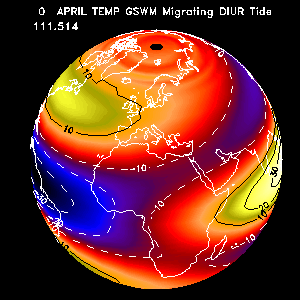
There is absolutely much to gain in the positive, constructive use of precedents, models, patterns, trends. Everyone knows from experience that knowledge is layer upon layer of built up inputs from one’s own and other’s experiences. The National Center for Atmospheric Research (NCAR) put up a Global Scale Wave Model (GSWM) that could provide a better understanding and forward perspectives on hydrologic movements around the world.


NCAR also has a program to monitor the sun’s activity under its High Altitude Observatory (HAO) due to the discovery by Dr. Richard Carrington of very powerful solar action that destroys or burns up electrical lines, electronic gadgets and disrupts regular human and societal activity.

Top: Image of the Sun taken on October 15 2013 by the Atmospheric Imaging Assembly (AIA) telescope that flies on the NASA Solar Dynamics Observatory (SDO) satellite. Most of the sunspot activity in this image can be seen in the Sun's Southern Hemisphere, while the Northern Hemisphere seems to have already gone through its peak in activity.

Middle: Shows a record of sunspot area measures going back to solar cycle 12 in 1898. Areas are measured in millionth of solar hemisphere and averaged over three solar rotations.
Bottom: A drawing by Johannes Hevelius created in 1644, one year before the start of the Maunder Minimum, shows the passage of a large spot across the solar disk, which occurred over eight consecutive days.

On the other hand, the Group on Earth Observations formulated the global earthquake model called Supersites wherein the chosen biggest candidate earthquake sites from all over the world are plotted upon the global map and constantly observed and monitored for seismic activity.


 Supersites

Shown below are the sample candidate big volcanic and earthquake sites that passed evaluation and are now included under supersites.


The earthquake faults at San Andreas, Iceland, Hawai’i, Italy’s Mt. Etna and New Zealand at this time are considered as permanent supersites.


The experience of the United States, Indonesia and other parts of Asia, together with many other countries in recent past on storm surge, the major Japan tragedy from tsunami, as well as the minor tsunami in Mindanao play a large role in understanding what happened in the recent Category 5 Hurricane Tropical Cyclone Haiyan (Yolanda) storm surges that hit the Visayas and parts of Mindanao.

Calamities emanating from many other forms of natural or even human-made causes, in various levels were also documented in the past.

By coordinating as much of the documented knowledge from these disasters, a key responsible institution such as a disaster forecasting or response agency (e.g. Mongolia Institute of Meteorology and Hydrology, United States of America’s US Geological Survey and the NOAA hurricane forecasting, the Philippines’ National Disaster Risk Reduction Management Council, etc.) will be able to cull the significant benchmarks on the kinds of natural or other occurrences and the various kinds of response to various calamities.

Thus, in the future, the lessons learned from this coordinating and compiling of data arising from experience of past calamities is a tool to help open the eyes of and enlighten officials, the scientific community, as well as the greater population, about future disasters.

With thorough information, it is possible to arrive at clearer forecasts. With such kind of forecasts the task of bringing down the information to the people is the next hurdle.

In the past, Centre di Humanes et Societas, Inc., together with the Office of Civil Defense, Department of National Defense, pushed for the installation of Public Warning Systems in the country as early as 1992. Until this time, it is awaited if the government will seriously consider putting up early warning for more people to survive during disasters.

Equipped with public address systems, computers and in areas where needed also with electric power generators. The command and control console enables the system operators to monitor the dissemination of advisories and warnings to the public on a one-way, feed-forward basis.

The feature of the Public Warning System being proposed at the time (1992) had the capability to integrate announcements to the public through a network of public address systems to radio, television and mobile phone frequencies to increase the number of recipients that will get the warnings.

Like the Philippines, too many countries up to this time, do not have adequate forecasting and public warning systems. This was evident even in the occurrence of the Bandar Aceh, Indonesia tsunami that extended up to the Indian peninsula leaving more than two hundred thousand people dead; the Haiti earthquake that claimed 300,000 lives; the Japan earthquake and tsunami that left tens of thousands dead; the recent super typhoon Yolanda that killed nearly 10,000 victims and a score of other disasters all around the world.

Notwithstanding having powerful forecasting capability, the future of any country in confronting calamities is uncertain in areas where people refuse to cooperate, fiercely resist efforts to evacuate them from their present niche despite the high risk from calamities or simply shun any other efforts to forestall dangers to life and property. Governments are not always inclined to move them by force or attempt to evacuate at all.

HMES since November 2009 sought to generate strong focus on targeted solutions to specific issues all of which serve to strengthen a state’s capacity to improve forecasting and enhance its disaster readiness:

1.  Encourage broad policy regime change, paradigm shift, to enable governments to undertake interventions to reduce hazards including but not limited to, modernizing the state’s forecasting capability.

2.  Foster a culture shift for the people not to stand in the way of reform, change and intervention.

3.  Enjoin the compiling of all available earthquake, hydrogeologic and meteorologic models, among others into a Global Geohazard System.

4.  Factor in natural aside from industrial causes Greenhouse Gases (GHG) into Disaster and Climate Change risk parameters.

5. Study natural and man-made land deformations or wetlands defacements including altering life and inorganic objects therein should be seriously studied and factored into future Disaster Risk Reduction (DRR) activities.

6.  Signing Declaration to observe a particular year as International Hazard Mapping Year.
7.  Signing Declaration for observing a particular month of every year thereafter as the Disaster Risk Reduction Month.

8.  Signing Declaration for observing a particular date of a month of every year thereafter as the International Hazards Awareness Day.

9.  Signing expanded agreements between UN, member nations on sharing of GIS on disasters and information from outer space.

10.  Signing Declaration making outer space information and GIT Infrastructure more available for the poor nations.

11. Publish both government and international combines’ data on geohazard whether on natural setting or involving human-made structures.

12.  Amend all obsolete national or state laws, statutes, rules and regulations that instead of engendering disaster risk mitigation, will only become the cause for greater casualties and devastation during disaster.

13.  Internationally criminalize persons and institutions that place the lives of individuals and whole populations in danger from forthcoming disaster or exacerbate the miserable fate of victims after a disaster.

14.  Unify policy advocacy in the public sector by rationalizing the assigning of functions and responsibilities to both individuals and agencies.

15.  Whether by public sector effort or private sector initiative, to build the Philippines’ Geohazard Mapping and Emergency Communications Center.

16.  Signing Declaration imposing the act of relocating habitats that lie directly upon the path of disaster and enjoin the international private enterprise sector to support, apart from government’s efforts, private-led initiatives to help reconstruct for and resettle communities vulnerable to disasters.

Related Topics:

For relocation away from danger zones:

KORONADAL CITY (MindaNews/4 November)– The city government is planning to develop a 2.4-hectare resettlement area for local residents situated in calamity danger zones and those who were displaced by the recent floods and landslides that hit the area. Read more here >>

As a first priority, the assessment should determine the safety of damaged buildings for human use.
This will be followed by the estimation of reconstruction costs of buildings and other infrastructure in each sector of the economy. Assessment must determine the costs of the introduction of hazard safer construction measures. This will include the need for strengthening or relocation of buildings and facilities to ensure their safety from future events. >>

BAGUIO CITY—Encouraged by Malacañang’s decision to proceed with the relocation of squatters lining Metro Manila waterways, provinces in north and Central Luzon have decided to resettle communities living in geologically hazardous areas to reduce flooding and landslides. >>
Secretary Florencio Abad: “Besides relocating poor families particularly those in flood-prone or high-risk areas, this fund release will also allow SHFC to give poor families the opportunity to secure their own property,” >>

The Country Fire Service have developed a fact sheet to communicate the Fire Danger Ratings; Severe, Extreme and Catastrophic, click here for Fire Danger Ratings.
CFS have also development fact sheets explaining where to relocate on the days of Severe, Extreme and Catastrophic Fire Danger, which can be sourced from the link below: >>

… Of specific interest was to learn from those people responsible for the evacuation process and shelters, and the subsequent reconciliation of family, donated goods management, housing recovery process and relocation challenges. >>

In 2006, one of the world's worst landslide hit Southern Leyte that almost wiped out the entire 480 hectares in Barangay Guinsaugon, one of the 16 villages of the town of St. Bernard. The disaster left in its wake 28 injured, 410 registered survivors and buried alive at least 1,000 people >>

… The alert level for the Mayon volcano went down to 2 on the 13 January and most families have been able to return to their communities. However, there are plans in place to permanently relocate the families who live within the 6km permanent danger zone. UNICEF contributed with water kits, medical supplies, tents, information support materials and psycho social activities during the evacuation. >>

Comparative view:

Forced migration due to climate change will present one of the most severe challenges to the resilience of communities forced to migrate as well as to local and national governments. The Intergovernmental Panel on Climate Change (IPCC) has identified the regions of the world most vulnerable to climate change and predicts that 150 million people will be displaced by 2050. Erosion, flooding, and sea level rise will be the primary causes of displacement. Water and food security issues, due to drought and salt water intrusion, will also impact the sustainability of communities. >>

The need to relocate entire communities as a result of climate-induced environmental change is an extreme form of adaptation. If climate-induced environmental change renders entire communities uninhabitable, it is critical to understand the governance tools and human rights protections that can foster community resilience. Newtok's relocation provides an example of a model governance structure where the Newtok Traditional Council is leading the community's relocation effort and federal, state and tribal governmental and non-governmental organisations are providing the community with the technical assistance needed to build the infrastructure at the relocation site. However, despite this model working group, the institutional barriers to the relocation process have been enormous.  >>

·       Relocation is not only about rehousing people, but also about reviving livelihoods and rebuilding the community, the environment, and social capital. >>